


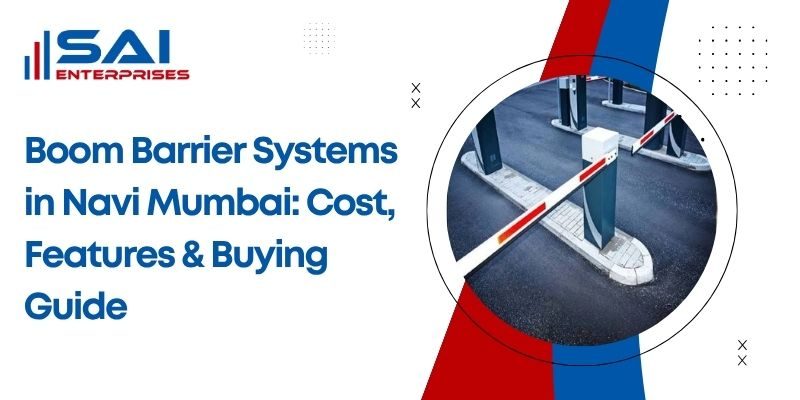
Boom Barrier Systems in Navi Mumbai: Cost, Features & Buying Guide
Boom barrier systems in Navi Mumbai help housing societies, offices, factories, warehouses and commercial properties control vehicle entry, organise traffic and connect parking entrances with modern access-control systems. The right choice depends on traffic volume, lane width, opening speed, safety sensors, access method and installation conditions.
For a small premises, a remotely operated barrier may be enough. A busy residential society or commercial facility may need RFID, vehicle detection, CCTV or number-plate recognition integrated into the entry and exit workflow.
The important decision isn’t simply which boom barrier looks strongest. You need to understand who should enter, how they will be authorised, how frequently the barrier will operate and what should happen during power or equipment failure.
What Is a Boom Barrier System?
A boom barrier is a vehicle-control system that raises or lowers a horizontal arm across an entrance. Depending on the configuration, security staff, remote controls, RFID credentials, sensors, access-control software or number-plate recognition can authorise the barrier to open.
A typical system contains:
- Barrier cabinet
- Motor and drive mechanism
- Boom arm
- Control board
- Remote or push-button controller
- Safety photocell
- Vehicle loop detector where required
- Power supply
- Manual release
- Optional RFID reader
- Optional ANPR camera
- Optional LED or traffic-light indicators
- Backup power where specified
The barrier itself is only one part of the access process.
For example, consider a housing society in Vashi with 250 resident vehicles and regular visitors. A remote-control barrier may technically open and close the gate, but it doesn’t automatically identify residents.
An RFID-based system can recognise authorised vehicles, while visitors continue through a security verification process.
Boom Barrier vs Access-Control System
| Requirement | Boom Barrier Only | Integrated Vehicle Access Control |
| Physically controls vehicle lane | Yes | Yes |
| Remote opening | Usually | Usually |
| Automatically identifies residents | No | Yes, with RFID/ANPR |
| Maintains access events | Limited | Possible |
| Connects with CCTV | Optional | Recommended where required |
| Visitor-management workflow | Manual | Can be integrated |
| Best suited for | Basic traffic control | Managed premises with regular vehicle movement |
A boom barrier should therefore be treated as the physical traffic-control layer, while authentication technology determines who should be allowed through.
Which Type of Boom Barrier Should You Choose?
Choose a barrier according to traffic frequency, available space, lane width, security workflow and operating environment. Manual barriers suit occasional access, while automatic systems are more practical where vehicles enter frequently and guards or electronic access systems must control movement efficiently.
Manual Boom Barrier
A manual barrier is physically lifted and lowered by a person.
It can work for:
- Low-traffic sites
- Temporary entrances
- Small compounds
- Construction areas
- Locations where automation isn’t justified
The main disadvantage is dependence on an operator.
Automatic Boom Barrier
An automatic boom barrier Navi Mumbai property owners install uses a powered motor and controller to raise and lower the arm.
Operation may be triggered through:
- Remote control
- Push button
- RFID
- Access-control panel
- Loop detector
- ANPR
- Visitor-management software
Automatic operation is particularly useful where reducing delays at the entrance matters.
Straight-Arm Barrier
Straight arms work well where there is adequate vertical clearance above the entrance.
They are commonly suited to:
- Housing societies
- Factory entrances
- Open parking areas
- Office campuses
- Schools
- Warehouses
Folding Boom Barrier
A folding arm is useful where overhead clearance is restricted, particularly in covered or basement parking areas.
Rather than requiring the full boom length vertically when raised, the arm folds as it opens.
High-Speed Barrier
Busy access points may benefit from a faster operating mechanism.
However, don’t select opening speed alone. A faster barrier also needs an appropriately designed vehicle-detection and safety workflow.
What Features Matter Most in Boom Barrier Systems in Navi Mumbai?
The most useful features are appropriate arm length, dependable motors, suitable opening speed, obstacle detection, manual emergency release, weather-resistant equipment and compatibility with the access method your property actually uses. High-traffic sites should also consider duty cycle and backup arrangements.
1. Correct Boom-Arm Length
Measure the controlled vehicle lane rather than ordering an arm based on guesswork.
Longer isn’t automatically better.
For a two-lane entrance, it may sometimes be operationally better to control entry and exit separately instead of spanning both directions with one oversized arm.
2. Opening and Closing Speed
Vehicle volume determines how quickly the gate must process traffic.
Current products in the market demonstrate how specifications vary. For example, one Navi Mumbai-listed automatic unit specifies a 3-second operating speed, while an eSSL boom-barrier model specifies approximately 6 seconds for up/down operation.
The right speed is the one that balances throughput with safe operation at your entrance.
3. Photocell Safety
A photocell detects an obstruction across its beam.
If a car remains under the boom, the controller can use that signal as part of the safety logic rather than simply lowering the arm according to a timer.
4. Loop Detector
An induction loop installed into the road surface can detect a vehicle within a defined area.
It may be used to:
- Detect vehicle presence
- Prevent premature closing
- Trigger exit operation
- Support parking workflows
5. Manual Release
A powered barrier needs a sensible contingency for power or equipment failure.
Staff should understand how to release or operate the barrier according to the manufacturer’s design rather than discovering the procedure during an emergency.
6. Outdoor Protection
Rain, dust, heat and daily outdoor exposure matter in Navi Mumbai.
Check:
- Enclosure protection
- Corrosion resistance
- Cabinet construction
- Outdoor connector protection
- Cable routing
- Foundation drainage
For comparison, eSSL lists IP54 protection on one current boom-barrier model. That does not mean IP54 is automatically the specification every site needs; it shows why enclosure protection is a specification worth checking before purchase.
How Much Does a Boom Barrier Cost in Navi Mumbai?
There is no single reliable boom barrier cost Navi Mumbai buyers can apply to every property. Equipment type, arm length, operating speed, motor, sensors, RFID or ANPR integration, civil work, cabling, backup power, installation and maintenance requirements all affect final project pricing.
Current publicly visible listings demonstrate the range.
One Navi Mumbai-related listing shows automatic boom-barrier equipment at approximately ₹40,000, while another automatic system is listed around ₹1.20 lakh. Other specialised configurations appear at still higher prices.
A semi-automatic Navi Mumbai listing, for example, shows approximately ₹75,000 before GST, while another specialised automatic product is listed around ₹1.80 lakh before GST.
These figures should not be treated as a quotation from Sai Enterprises. They are market examples showing why comparing only headline equipment prices can be misleading.
What Actually Changes the Installed Price?
| Cost Factor | Why It Matters |
| Barrier model | Motor, controller and operating specifications differ |
| Arm length | Longer lanes may require a different barrier configuration |
| Opening speed | High-throughput equipment can have different drive requirements |
| Photocells | Adds obstacle-detection capability |
| Loop detector | Requires detector hardware and road-loop installation |
| RFID | Adds readers, tags and access configuration |
| ANPR | Requires suitable cameras, software and network infrastructure |
| Civil foundation | Barrier cabinet needs stable installation |
| Cabling | Distance from power/control points changes work involved |
| UPS/backup | Adds resilience during power interruption |
| CCTV integration | May need additional cameras, recorder capacity or networking |
| AMC/support | Affects long-term operating expenditure |
Compare Installed Scope, Not Just Product Price
Suppose Vendor A quotes ₹45,000 for a barrier while Vendor B quotes ₹65,000.
The cheaper quote may initially appear better.
But if Vendor A excludes:
- Foundation work
- Safety photocells
- Loop detector
- Cabling
- Installation
- Transport
- GST
- Commissioning
the comparison isn’t meaningful.
Ask every supplier for a line-by-line scope.
Which Parking Boom Barrier System Suits Your Property?
The right parking boom barrier system depends on who uses the property and how vehicles are authorised. Housing societies usually prioritise resident convenience and visitor control, while factories and warehouses may need heavier-duty operation, truck access and integration with security procedures.
Site-to-System Selection Matrix
| Property Type | Recommended Starting Configuration | Useful Integration | Key Question |
| Housing society | Automatic barrier | RFID + guard control + CCTV | How will residents and visitors be separated? |
| Office building | Automatic barrier | RFID/access control | Are employee vehicles pre-authorised? |
| Factory | Heavy-use automatic barrier | Access control + CCTV | How many daily vehicle cycles occur? |
| Warehouse | Heavy-use system | Guard control + CCTV + RFID | Will trucks and cars use the same lane? |
| School | Controlled automatic barrier | Guard station + CCTV | How will peak-time traffic be managed? |
| Clinic/hospital | Automatic barrier | Guard control + emergency override | Can emergency vehicles enter immediately? |
| Commercial parking | Automatic/high-throughput barrier | Ticketing/RFID/ANPR | Is payment or occupancy tracking required? |
| Small private property | Remote automatic barrier | Remote controller | Is advanced identification actually necessary? |
Example: Housing Society
Imagine a Kharghar society with:
- 180 resident vehicles
- One entrance
- One exit
- Security guards
- Frequent food deliveries
- Guest parking
Giving every resident a handheld remote would create administrative problems.
An RFID-based resident workflow can be more practical:
Resident vehicle → RFID detected → authorised → barrier opens
while visitors follow:
Visitor arrives → guard verifies → access approved → barrier opens
Example: Warehouse
A warehouse in Taloja may have different requirements.
Truck movement, delivery records and long vehicles may make the following more important:
- Lane positioning
- Barrier-arm clearance
- Heavy-use operation
- Guard visibility
- CCTV coverage
- Manual override
- Safe waiting area
This is why the site survey should come before product selection.
How Does Boom Barrier Installation Work?
Professional boom barrier installation starts with the site rather than the equipment catalogue. The installer should assess traffic direction, lane width, foundation position, electrical supply, pedestrian movement, drainage, cable routes, safety detection and access-control requirements before mounting and commissioning the barrier.
A practical installation sequence is:
- Survey the entrance and measure the controlled lane: accurate dimensions determine arm length, cabinet position and whether separate entry and exit barriers make more operational sense.
- Map vehicle and pedestrian movement: the barrier should control vehicles without creating an unnecessary hazard or forcing pedestrians through the vehicle-control zone.
- Define the authorisation method: decide whether guards, remotes, RFID, ANPR, access-control software or another method will trigger entry before wiring and equipment are finalised.
- Prepare the foundation and electrical route: the barrier cabinet needs a secure mounting point, suitable power provision and protected wiring rather than temporary surface cabling.
- Install sensors and accessories: position photocells, loop detectors, readers or cameras according to the designed vehicle path so the automation logic receives reliable inputs.
- Configure opening and closing logic: set authorised triggers, safety behaviour and automatic closing according to site conditions rather than simply accepting unsuitable factory-default settings.
- Test realistic traffic scenarios: test residents, visitors, tailing vehicles, slow-moving cars, long vehicles, power interruptions and manual release before the system is handed over.
- Train security or facility staff: operators should know normal controls, emergency release, basic checks and whom to contact when a fault occurs.
According to the Bureau of Indian Standards, the National Building Code includes requirements covering building safety, fire and life safety, electrical installations and facility management. Entrance automation should therefore be planned without compromising applicable emergency access or building-safety requirements.
For high-rise and special buildings in particular, BIS building guidance identifies access for fire appliances and clear motorable access around the building as part of planning considerations.
What Access-Control Integrations Should You Consider?
Integrate the barrier only with technology that solves an actual access problem. RFID works well for repeat authorised vehicles, ANPR can identify number plates, loop detectors detect vehicle presence, while CCTV provides broader visual monitoring and evidence around the entrance.
RFID Access
An RFID boom barrier can work well for:
- Residents
- Employees
- Staff parking
- Registered commercial vehicles
The authorised vehicle carries or displays a compatible credential, depending on the chosen technology.
When it reaches the reader:
- Credential is detected.
- System checks authorisation.
- Barrier receives opening command.
- Vehicle passes.
- Barrier returns to the configured closed position.
For properties that also need employee or restricted-area authentication, a biometric access control system can manage people while RFID handles authorised vehicles.
ANPR Integration
ANPR Automatic Number Plate Recognition uses a camera and software to read vehicle registration numbers.
This can be useful where:
- Physical tags aren’t desirable
- Vehicle records are important
- Visitor pre-authorisation is needed
- Commercial parking needs automated identification
However, camera position, lighting, number-plate visibility, vehicle speed, network availability and software design all influence practical performance.
CCTV Integration
A barrier tells you whether an access event occurred.
CCTV can add visual context.
For example, a camera positioned at the entrance may help security staff review:
- Which vehicle entered
- Who was driving
- Whether another vehicle followed
- What happened during an incident
Businesses needing wider site surveillance can connect the entrance strategy with professional CCTV installation services in Navi Mumbai rather than treating each security device as an isolated system.
Remote or Guard Control
Not every entrance needs full automation.
A security guard using a push button or authorised remote can remain effective where:
- Traffic is moderate
- Every visitor requires manual verification
- The property already has staffed security
- Automated vehicle identification provides little extra value
The best system isn’t necessarily the most technically complicated one.
How Should a Boom Barrier Be Maintained?
Routine maintenance should check mechanical movement, arm alignment, mounting stability, sensors, electrical connections, controller operation, access readers, remote controls and manual release. High-use barriers deserve more frequent inspection because every vehicle cycle adds mechanical wear and exposes faults sooner.
Practical Maintenance Schedule
| Check | Suggested Routine |
| Visual arm/cabinet inspection | Regularly |
| Barrier movement | Regularly |
| Photocell function | Regularly |
| Remote/access reader test | Regularly |
| Manual release | Periodically |
| Mounting and fasteners | Periodically |
| Loop detector operation | Periodically |
| Electrical connections | During preventive service |
| RFID/ANPR integration | During preventive service |
| Full system servicing | According to manufacturer/service plan |
Actual maintenance intervals should follow the installed manufacturer’s requirements and the site’s traffic volume.
Watch for Early Warning Signs
Arrange inspection if you notice:
- Jerky arm movement
- Unusual motor noise
- Barrier failing to reach full position
- Intermittent remote response
- RFID recognition delays
- Photocell faults
- Arm bouncing excessively
- Cabinet movement
- Exposed or damaged cables
- Frequent controller resets
Waiting until the gate fails completely can be disruptive at a busy society or commercial entrance.
How Do You Choose a Boom Barrier Vendor in Navi Mumbai?
Choose a provider that surveys the entrance, explains the complete system architecture, specifies what is included in the quotation, installs appropriate safety accessories and provides commissioning and after-sales support. Comparing only equipment price can leave important civil, electrical and integration work uncovered.
Before approving a supplier, ask:
Site Planning
- Will you inspect the property before recommending equipment?
- What boom length is required?
- Is the proposed cabinet position suitable?
- How will pedestrians move around the barrier?
Equipment
- What motor and controller are supplied?
- What is the rated operating speed?
- Which arm length is supported?
- Is manual release available?
- What weather protection does the cabinet provide?
Safety
- Are photocells included?
- Is a loop detector required?
- What happens if a vehicle stops under the barrier?
- What happens during power failure?
Integration
- Does it support RFID?
- Can it integrate with CCTV?
- Can ANPR be added later?
- Can it integrate with existing access control?
Commercial Scope
- Is civil work included?
- Is cabling included?
- Are sensors included?
- Is GST included?
- Is commissioning included?
- What warranty applies?
- What maintenance support is available?
A detailed answer to these questions is more valuable than simply asking, “What is your cheapest boom barrier?”
Conclusion
Choosing boom barrier systems in Navi Mumbai should begin with traffic flow, lane dimensions, access rules and safety requirements not a catalogue price. A properly planned system can combine the barrier with RFID, CCTV, ANPR or existing access control while remaining straightforward for guards and authorised users.
Sai Enterprises provides site-specific boom barrier installation in Navi Mumbai for housing societies, offices, commercial properties, warehouses and industrial premises. Arrange a site assessment to determine the right barrier, accessories, integration requirements and installation scope for your entrance.
FAQ’S
Can a boom barrier work during a power cut?
Yes, but only when the selected configuration provides an appropriate backup or manual-release arrangement. Ask the installer exactly what happens when mains power fails, which components remain operational, and how security staff can open the entrance manually if normal powered operation isn’t available.
Can an existing CCTV system be connected with a boom barrier?
Yes, although the extent of integration depends on the installed CCTV, recorder, access-control platform and barrier controller. Even without direct software integration, cameras can monitor entry and exit lanes. More advanced systems may coordinate access events with vehicle images or number-plate recognition.
Is RFID better than a remote control for housing societies?
Often, yes particularly when many residents use the same entrance. RFID can identify registered vehicles without distributing and managing numerous handheld remotes. However, smaller societies with limited traffic may find guard-operated or remote-controlled barriers adequate, so the operational workflow should determine the technology.
Can the same barrier be used for both cars and trucks?
Yes, but the lane geometry, arm length, vehicle dimensions, turning movement, traffic frequency and detection position must suit both vehicle types. Warehouses and factories should test their longest regular vehicles during planning instead of designing the entrance around passenger cars alone.
Does a boom barrier completely prevent unauthorized vehicle entry?
No, a conventional boom arm primarily controls organised vehicle movement and access decisions. It shouldn’t automatically be treated as a crash-rated physical-security barrier. Properties with higher perimeter-security risks need an appropriate security assessment and potentially different vehicle-blocking equipment.
Can ANPR be added to an existing boom barrier later?
Yes, if the existing controller provides compatible integration and the site can support suitable cameras, networking and software. Planning spare connectivity and suitable camera locations during the original installation can make later ANPR expansion easier than redesigning the entrance after deployment.
