


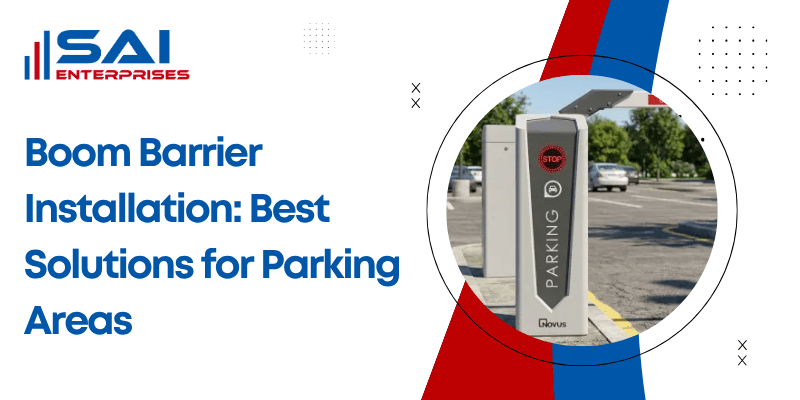
Boom Barrier Installation: Best Solutions for Parking Areas
Boom barrier installation works best when the barrier is matched to lane width, traffic volume, safety needs and access method. For Mumbai parking areas, professional planning should also account for monsoon exposure, power backup, vehicle sensors and integration with RFID or ANPR.
A parking barrier can look like a simple motor and arm, but the quality of the final setup depends much more on what happens before that arm is fitted. Lane geometry, foundation stability, vehicle flow, pedestrian movement, access permissions and safety sensors all affect day-to-day reliability.
For housing societies, offices, factories, warehouses, schools, clinics and commercial properties in Mumbai and Navi Mumbai, the objective shouldn’t simply be to block a driveway. The system should control vehicles without creating unnecessary queues, unsafe arm movement or constant intervention from security staff.
Key Takeaways
- Match the barrier arm and opening speed to the actual parking lane and traffic volume.
- Use automatic barriers for frequently used society, office and commercial parking entrances.
- Plan vehicle detection and anti-fall safety devices before commissioning the gate.
- RFID, UHF and ANPR can reduce manual vehicle verification at busy entrances.
- Basement parking may require folding or articulated arms where overhead clearance is limited.
- Mumbai outdoor installations should account for drainage, rain exposure, corrosion and reliable power arrangements.
- Treat maintenance as part of the parking access system, not as something to arrange only after a breakdown.
Table of Contents
- What should you check before installation?
- Which barrier is best for different parking areas?
- What is the GATE-5 parking fit check?
- How does an automatic barrier work?
- What does professional installation involve?
- Which safety and access-control features matter?
- How much does installation cost in Mumbai?
- How should a parking barrier be maintained?
- When should you use a professional installer?
- FAQs
What Should You Check Before Boom Barrier Installation in a Parking Area?
Before choosing a parking barrier, check the clear lane width, overhead clearance, daily traffic pattern, vehicle mix, pedestrian movement, drainage, power availability and emergency access. These site conditions determine the arm type, operating speed, sensor layout and control method you actually need.
The mistake to avoid is choosing a barrier from a catalogue first and trying to make the entrance fit it later.
Measure the usable lane, not just the gate opening
Measure the actual path vehicles will travel through. Columns, kerbs, security cabins, turning angles and separate pedestrian paths may reduce the usable width even when the main gate itself looks wide.
A four-metre gate, for example, does not necessarily mean a four-metre barrier arm is the correct answer.
The installer should check:
- clear vehicle passage width;
- cabinet position;
- boom-arm travel;
- turning radius near the gate;
- height restrictions;
- pedestrian routes;
- security cabin position; and
- space required for sensors and readers.
Check overhead clearance
This becomes especially important in Mumbai apartment basements and covered commercial parking areas.
A straight arm rises vertically. If the parking entrance sits below a slab, canopy, duct or signboard, a folding or articulated arm may be more suitable.
Understand the vehicle mix
A society gate mainly handling cars has different detection requirements from a warehouse entrance that regularly receives SUVs, delivery vans and trucks.
Two-wheelers create another issue because the system must be planned around the way they actually pass through the entrance rather than assuming every vehicle follows the centre of the lane.
Plan for Mumbai weather
Outdoor cabinets, connectors and cable routes face heavy seasonal rain, standing water and humidity.
The installation location should therefore be selected so water does not collect around the cabinet or underground connections. Outdoor wiring, cable glands and enclosures should be selected according to the chosen manufacturer’s requirements.
Which Boom Barrier Is Best for Different Parking Areas?
The best barrier depends on how the parking entrance is used. Standard automatic barriers suit most societies and offices, high-speed models suit busy gates, folding arms suit low-clearance basements, while manual barriers are better for low-traffic sites with simple access needs.
| Parking situation | Suitable barrier | Typical control method | Main consideration |
| Small private parking area | Manual or basic automatic | Remote/push button | Low traffic volume |
| Housing society | Automatic | RFID/UHF + guard override | Resident and visitor flow |
| Office parking | Automatic | RFID/card/UHF | Employee access |
| Busy commercial parking | High-speed automatic | ANPR/RFID/software | Queue reduction |
| Basement entrance | Folding/articulated boom | RFID/remote | Low ceiling clearance |
| Factory or warehouse | Heavy-duty automatic | UHF/ANPR/guard control | Frequent or larger vehicles |
| School or clinic | Automatic with strong safety sensing | Guard/RFID/visitor approval | Mixed pedestrian and vehicle movement |
Automatic barrier
An automatic barrier uses a motorised mechanism and electronic controller to raise and lower the arm.
It is generally the most practical option for parking gates used throughout the day because it can work with remote controls, readers, vehicle detectors and parking-management systems.
High-speed barrier
Opening speed becomes more important as traffic volume increases.
A gate serving dozens of vehicles around an office shift change or residential peak period should not be designed exactly like a low-use warehouse side entrance.
Folding barrier
Folding arms solve a physical problem rather than simply adding an extra feature.
They are useful where the ceiling prevents a normal straight arm from reaching its fully raised position.
Manual barrier
Manual barriers can still make sense where vehicle frequency is low and automated access records aren’t required.
They may, however, become inconvenient where the guard must repeatedly leave the security cabin to raise and lower the arm.
What Is the GATE-5 Check for Choosing a Parking Barrier?
GATE-5 is a practical pre-installation framework: Geometry, Access, Traffic, Environment and Emergency. Checking these five areas before selecting equipment helps prevent common mismatches such as an oversized arm, slow gate cycle, poor sensor placement or a barrier that obstructs emergency movement.
Use this framework during the first site inspection.
| GATE-5 factor | Questions to answer |
| G – Geometry | What is the clear lane width? Is vertical clearance restricted? Where can the cabinet sit? |
| A – Access | Who should enter automatically: residents, staff, visitors, delivery vehicles or all four? |
| T – Traffic | How busy is the gate during peak periods? What types of vehicles use it? |
| E – Environment | Is the barrier outdoors, in a basement, near standing water, dust or heavy vehicle activity? |
| E – Emergency | How will the barrier open during a power failure, equipment fault or emergency vehicle movement? |
Illustrative Mumbai society example
Consider a housing society with one narrow entrance used by resident cars, delivery vehicles, two-wheelers and visitors.
Installing the fastest barrier available won’t automatically solve the problem.
A better design could combine resident RFID access with guard-controlled visitor entry, vehicle-presence sensing and a clearly defined manual override procedure. CCTV can then monitor the gate while the barrier controls physical vehicle movement.
Sai Enterprises already provides CCTV installation services and biometric access control systems, allowing the parking entrance to be planned as part of a broader security system rather than as an isolated machine.
How Does an Automatic Boom Barrier System Work?
An automatic boom barrier system receives an access signal, accepts the trigger, raises the arm, keeps the lane protected while the vehicle passes, and lowers the arm after clearance. RFID, ANPR, remotes, push buttons and parking software can provide that trigger.
A typical sequence looks like this:
Vehicle approaches → Identification or approval → Barrier opens → Vehicle passes → Safety system confirms clearance → Barrier closes
Remote or push-button control
The simplest automated arrangement leaves the access decision with the security guard.
Once the vehicle is approved, the guard presses a button or remote control to open the gate.
RFID or UHF access
Registered vehicles can carry an authorised tag that communicates with a compatible reader.
This can reduce repetitive manual verification for residents or employees.
ANPR access
Automatic Number Plate Recognition uses a camera and software to identify the vehicle’s registration plate and apply predetermined access rules.
Hikvision’s current vehicle-access architecture, for example, shows ANPR cameras and UHF readers working alongside barrier gates and anti-fall radar rather than treating the barrier as a standalone product.
Integrated visitor access
Housing societies can combine the parking gate with visitor communication.
For example, a guard can verify a visitor through an intercom system for residential buildings or another visitor-management process before opening the vehicle barrier.
What Does Professional Barrier Installation Involve?
Professional installation normally moves through site survey, civil foundation preparation, conduit planning, cabinet mounting, arm balancing, control and safety-device connection, configuration, testing and operator handover. The exact sequence should follow the selected manufacturer’s instructions because foundations, wiring and settings vary by model.
The installation should therefore be treated as a coordinated civil, electrical and access-control project.
1. Site survey
Measure the lane, clearances and vehicle path: the physical layout determines the barrier position, boom configuration and sensor arrangement before civil work begins.
2. Foundation and cabinet position
Prepare a stable base to the selected manufacturer’s specification: a moving barrier places repeated mechanical loads on its mounting, so poor alignment or an unstable base can affect long-term operation.
3. Cable and conduit planning
Plan power, controls, readers and detector routes before completing civil work: retrofitting forgotten conduits later can create exposed wiring, extra cutting and unnecessary disruption around the parking entrance.
4. Barrier cabinet mounting
Install the cabinet level and in the surveyed position: correct alignment supports predictable boom movement and keeps the arm aligned with the controlled lane.
5. Boom-arm fitting
Fit and balance the correct arm according to the model instructions: arm length, weight and counterbalance requirements differ between barrier models and directly affect motor operation.
6. Safety-device installation
Position compatible radar, loop detectors or photocells around the vehicle zone: the controller needs reliable information about whether the lane is occupied before the arm is allowed to close.
According to CAME, automatic-barrier accessories can include flashing lights, photocells and loop detectors, with these safety features intended to improve operation around vehicles and busy traffic areas.
7. Access-control configuration
Connect and configure the chosen access method: RFID, UHF, ANPR, remote controls or another compatible system should trigger the barrier only according to the intended parking workflow.
8. Commissioning and handover
Test normal, blocked-lane and exception scenarios before handover: the team should confirm arm travel, vehicle sensing, authorised entry, visitor handling and the site’s agreed response to faults or power loss.
This step is where a collection of individual devices becomes a functioning boom barrier for parking.
Which Safety and Access-Control Features Matter Most?
The most important features are reliable vehicle detection, anti-fall protection, visible warning indicators, manual or backup operation, secure access triggers and proper logging where needed. For busy parking areas, the barrier should also integrate cleanly with RFID, ANPR or existing access control.
Vehicle-presence detection
The system should know when a vehicle is beneath or immediately around the arm.
Depending on the product and site, this can involve:
- inductive loop detection;
- radar;
- photocells;
- laser detection; or
- a combination of supported technologies.
CAME describes photocells as infrared safety devices designed to monitor the gate’s movement area, while Hikvision offers radar designed to prevent a barrier pole from falling while a pedestrian or vehicle is passing.
Warning visibility
Reflective arm markings, LEDs or warning lights help approaching drivers recognise the position and movement of the barrier, particularly at basement entrances or poorly lit parking areas.
Manual or backup operation
Every property should know what happens when normal automatic operation is unavailable.
That doesn’t mean every site needs the same backup arrangement. The correct solution depends on the equipment, security policy and whether uninterrupted access is critical.
RFID versus ANPR
Neither technology is automatically “better”.
RFID/UHF can be highly practical for known residents or employees. ANPR can reduce the need to distribute physical tags and can support number-plate-based workflows.
Sites may also combine the technologies.
CCTV around the parking entrance
A barrier controls whether vehicles can move through the gate. CCTV provides visual monitoring and recorded context.
Using both creates a stronger entrance-security workflow than expecting either system to perform both jobs.
How Much Does Boom Barrier Installation Cost in Mumbai?
The installed price varies because the barrier unit is only one part of the project. Arm length, motor duty, foundation work, cabling, loop or radar sensors, RFID or ANPR integration, backup power and site complexity can materially change the final Mumbai quotation.
Current Mumbai supplier listings show examples of automatic barrier hardware around ₹32,500–₹35,000 at one supplier, while another lists systems around ₹60,000–₹90,000 depending on the model. These are advertised equipment prices, not a universal installed-project rate.
A better quotation should separate the project into its actual components.
| Cost factor | Why it changes the quotation |
| Barrier model | Motor, duty rating and operating speed vary |
| Boom length/type | Longer, folding or specialised arms change hardware requirements |
| Foundation | Existing concrete and new civil work require different preparation |
| Sensors | Radar, loop detectors and photocells add equipment and setup |
| Access method | Remote control is simpler than RFID/UHF or ANPR integration |
| Cabling/networking | Distance to power, guard cabin and network equipment matters |
| Backup requirement | UPS/battery arrangement depends on the system |
| Number of lanes | Separate entry and exit barriers increase equipment and integration |
| Site conditions | Basement work, trenching and active traffic can increase labour |
For a site-specific quotation, the better approach is a survey rather than choosing a barrier from an advertised unit price.
Property owners looking for professional boom barrier installation in Mumbai can use the existing Sai Enterprises service page for commercial enquiries and system selection.
How Should a Parking Boom Barrier Be Maintained?
A parking barrier should be inspected on a planned schedule rather than only after it fails. Cleaning sensors, checking arm movement, inspecting fixings, testing safety devices and reviewing access-control performance help identify small problems before they become gate downtime or vehicle-safety issues.
The correct service interval should ultimately follow the manufacturer, duty cycle and operating environment.
A useful planning schedule is:
| Frequency | Practical checks |
| Weekly/regular visual check | Arm damage, warning lights, unusual movement, obvious obstructions |
| Monthly operational check | Open/close behaviour, remotes/readers, basic sensor response |
| Quarterly preventive review | Fixings, wiring condition, sensors, cabinet condition, access logs |
| Periodic professional service | Motor/drive inspection, detailed safety testing, alignment and configuration |
| After an impact or flooding event | Stop, inspect and recommission before normal use if operation may be affected |
High-traffic factory gates may need attention more frequently than a lightly used private parking entrance.
Mumbai properties should also watch for:
- water entering cable routes;
- mud or debris near detector areas;
- corrosion around exposed hardware;
- damaged reflective strips;
- loose or bent arms; and
- sensor alignment problems after site work.
For broader preventive support, Sai Enterprises also has information on annual maintenance services for security systems in Mumbai.
When Should You Choose Professional Installation in Mumbai?
Choose professional installation when the barrier will operate daily, connect to mains power, control a shared parking entrance, integrate with access systems or protect a high-traffic site. A trained installer can coordinate civil, electrical, safety and commissioning work as one functioning system.
Professional involvement becomes especially valuable where several technologies must work together.
That may include:
- boom barrier;
- RFID or UHF reader;
- ANPR;
- CCTV;
- access-control software;
- intercom;
- guard controls;
- vehicle detectors; and
- backup power.
Sai Enterprises’ existing service portfolio includes boom barriers, CCTV, biometric access control, video door phones and intercom systems, which makes integrated entrance planning possible from one broader security perspective.
For a residential society, that could mean resident vehicle automation plus visitor communication.
For an office, it could mean employee vehicle credentials plus CCTV monitoring.
For a factory or warehouse, it could mean controlled vehicle movement supported by guard approval and access records.
The right design depends on the site rather than a single standard package.
Conclusion
The best boom barrier installation is designed around the parking lane, traffic pattern, safety zone and access workflow, not simply the cheapest motor or longest arm. Mumbai properties benefit most from a site-specific system that is tested, maintainable and suited to local conditions.
If you’re planning a parking-access upgrade for a housing society, office, factory, warehouse, school, clinic or commercial property in Mumbai or Navi Mumbai, contact Sai Enterprises for a site assessment and a solution matched to your entrance and security requirements.
FAQ’S
Can an automatic boom barrier work during a power cut?
Yes, most automatic barriers can be configured with a manual release, battery backup or another fail-safe arrangement, depending on the model. For shared parking gates, decide the outage procedure before commissioning so security staff know how to keep vehicles moving safely when mains power is unavailable.
Can a boom barrier work without the internet?
Yes, a basic barrier can operate locally through a remote, push button, loop detector or standalone access controller without internet. Internet connectivity becomes useful when you want cloud management, remote monitoring, centralised logs, mobile access or integrations that depend on online software services.
Can one boom barrier manage both entry and exit?
Yes, but only where the lane design and traffic pattern allow controlled alternating movement. A single barrier can manage a shared entry-and-exit lane with suitable sensors and operating rules, although separate lanes are usually easier to manage at busy sites with simultaneous two-way traffic.
How long does a boom barrier project take to install?
A straightforward single-lane project may be completed quickly once the foundation, cabling and equipment are ready, but civil curing and integration work can extend the schedule. The installer should confirm the timeline after the site survey because foundation design, trenching and access-control complexity vary.
Does an automatic parking barrier still need a security guard?
No, not always. RFID, UHF, ANPR or other access-control methods can automate authorised vehicle entry. A guard may still be useful for visitors, exceptions, deliveries and incident handling, especially at housing societies, schools, clinics or commercial sites with mixed vehicle and pedestrian movement.
What should you do if a vehicle hits the boom arm?
If a vehicle hits the arm, stop using the barrier until the arm, mounting assembly, motor and safety devices are checked. Some systems offer breakaway or anti-collision features, but damage can still affect alignment or safe movement. Recommission the barrier after any repair before returning it to normal service.
